
Quick Takeaways
If you want to choose AI tools well in 2026, focus on these first:
- Start With A Real Business Problem
- Check Integrations Before Features
- Match The Tool To Your Business Size
- Run A Small Pilot Before Full Rollout
- Prioritize Security, Governance, and Adoption
(This visual was created with AI assistance for illustrative and educational purposes.)
Why Picking The Right AI Tool Is Harder In 2026
Choosing AI tools is harder now because the market is bigger, noisier, and more crowded than it was in 2025. Most businesses are no longer asking whether to use AI. They are asking which tools are actually worth adopting, which ones fit current operations, and which ones create more complexity than value. WRITER’s 2026 enterprise AI survey found that adoption is widespread, but 79% of organizations still face challenges adopting AI, with many also struggling to prove ROI.
1. Start With The Problem, Not The Tool
The strongest AI decisions still begin with one simple question:
What Is Slowing The Business Down Right Now?
That might be:
- Slow Lead Qualification
- Repetitive Support Work
- Manual Internal Reporting
- Content Production Bottlenecks
- Knowledge Management Problems
- Fragmented Workflows Across Apps
AI is not the strategy. It is the operating layer that helps the strategy move faster.
A sales team losing hours on lead qualification has a different AI need than a support team drowning in repetitive tickets or a marketing team trying to keep output consistent. That is why the first step is always operational clarity. The wider shift in business strategy and real AI workflows makes this even more important.
2. Check Integrations Before Features
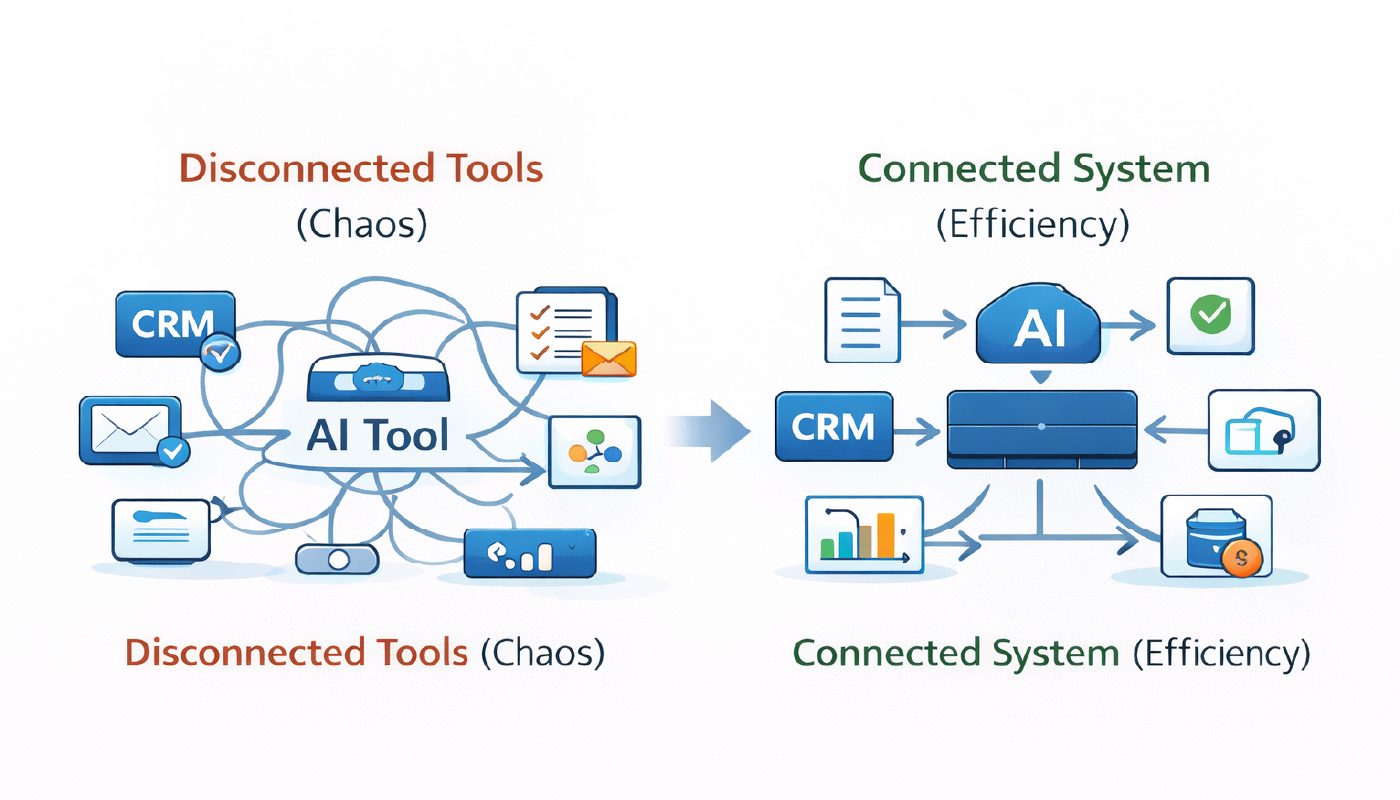
A tool can look impressive in a demo and still fail in real use if it does not connect properly to the systems your team already uses.
The real questions are:
- Does It Connect To Your CRM?
- Does It Work With Your Email, Helpdesk, Docs, Or Task Tools?
- Can It Fit Into Current Processes Without Heavy Rebuilding?
- Will It Save Time Or Create Another Silo?
This matters even more in 2026 because AI is no longer just about chat interfaces. It is increasingly about orchestration across apps. Zapier now positions itself around AI workflows and agents, including connections across 400+ AI tools and 9,000+ apps, which reflects where the market has moved.
(This visual was created with AI assistance for illustrative and educational purposes.)
3. Match The Tool To Your Business Size
(This visual was created with AI assistance for illustrative and educational purposes.)
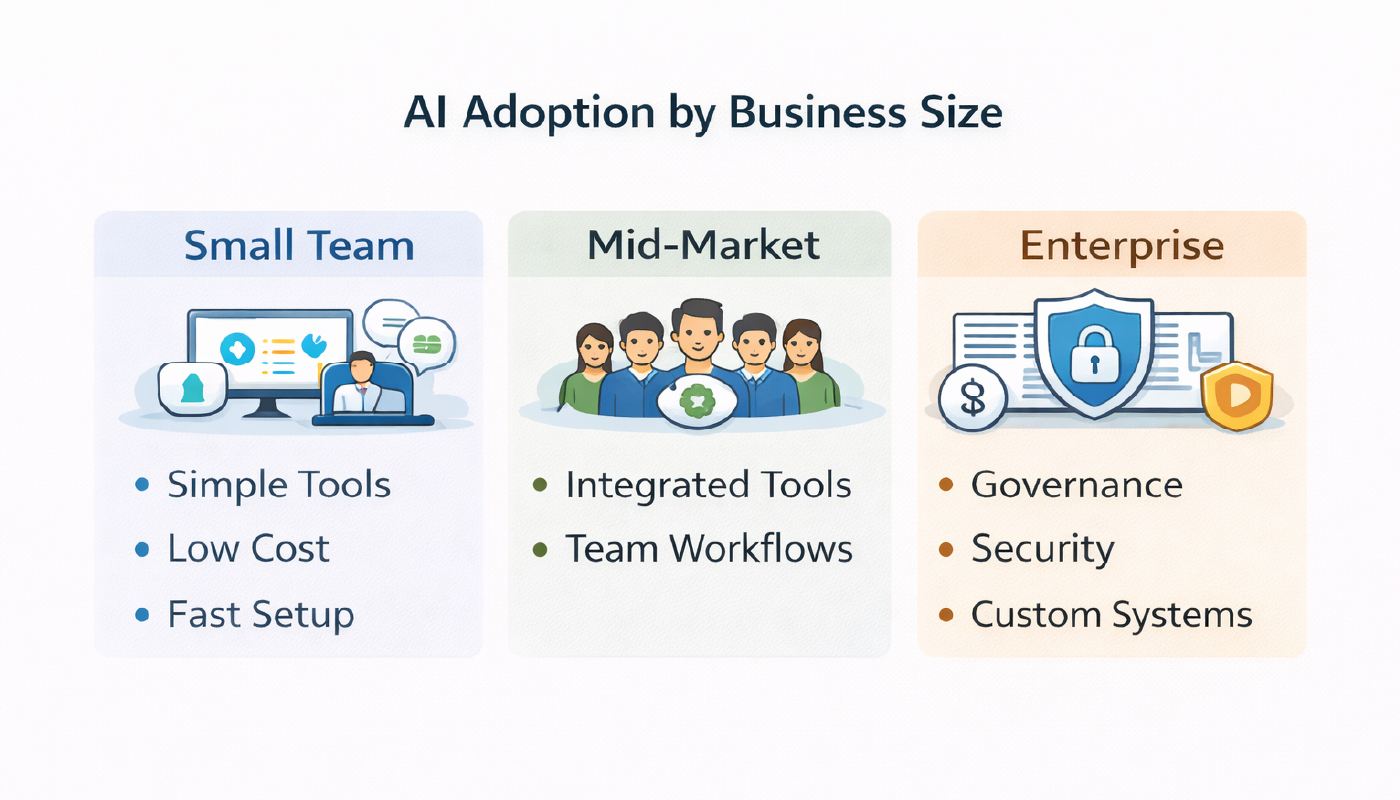
Not every company needs enterprise-grade AI on day one. At the same time, not every team can rely on lightweight tools forever.
For Small Teams
Lean teams usually need tools that are affordable, fast to deploy, and easy to use without technical overhead.
Common fits include:
- Workflow Automation
- Internal Writing And Note Support
- Lightweight Customer Chat Automation
- Sales Or Support Copilots
This is why many smaller teams begin with documentation, task automation, or AI-assisted support before moving into heavier systems. A practical starting point is understanding the current AI tools landscape and choosing tools that remove one clear bottleneck first.
For Mid-Market And Scaling Teams
Scaling businesses usually need stronger controls, deeper integrations, and a more structured rollout. This is where tools built around brand consistency, CRM workflows, internal search, team permissions, and governed content creation start to matter more.
For Enterprise
At the enterprise level, the requirements change again. You are usually looking for:
- Auditability
- Security And Privacy Controls
- Identity And Access Management
- Model Governance
- Scalable Agent Deployment
- Vendor Support And Procurement Readiness
Google positions Vertex AI Agent Builder as a suite for building, scaling, and governing AI agents in production, and Microsoft positions Foundry around building, optimizing, and governing AI apps and agents with unified security and governance.
4. Run A Small Pilot Before Full Rollout
This is one of the biggest missing steps in weak AI buying decisions.
Before committing to a tool across the company, run a small pilot with:
- One Clear Use Case
- One Team Or Department
- One Defined Timeframe
- One Success Scorecard
A pilot should answer:
- Did It Save Time?
- Did It Reduce Manual Work?
- Did It Improve Speed, Accuracy, Or Output?
- Did The Team Actually Use It?
Good AI buying in 2026 is not about rolling out the biggest tool. It is about validating a real workflow before scaling it. WRITER’s 2026 data is a useful reminder here because organizations are still spending heavily on AI while many struggle to show results.
5. Define ROI Before You Buy
A lot of companies still buy AI tools backwards. They buy first, then try to figure out whether the cost was justified.
A better process is to define ROI early.
That usually means deciding what you are trying to improve:
- Time Saved
- Cost Reduced
- Errors Reduced
- Tickets Resolved Faster
- Leads Qualified Faster
- Content Produced Faster
- Revenue Supported
This matters because adoption alone is not proof of value. A tool that gets attention for a month and then fades into the background is not a win. A simpler tool with measurable gains is often the better choice.
6. Check Whether The Tool Can Actually Adapt
Some tools stay fixed. Others improve as they work with your processes, knowledge, or workflows.
In 2026, stronger AI tools will often support at least one of these:
- Custom Instructions Or Business Rules
- Internal Knowledge Retrieval
- Agent Workflows
- Model Configuration
- Process Automation Based On Repeated Tasks
This is where generative AI and operational AI start to separate. One helps create output. The other helps run systems. Notion AI, for example, is now positioned around agents, enterprise search, and workspace actions rather than just note assistance.
7. Prioritize Security, Privacy, And Data Control Early
This is not optional anymore.
Businesses need to ask:
- Will Our Data Be Used To Train The Vendor’s Model?
- What Certifications Does The Vendor Have?
- Are There Admin Controls, SSO, And Access Rules?
- Is There Support For Data Residency Or Governance?
- Can We Control Which Teams Use Which Tools?
OpenAI’s business privacy materials say business data is not used to train models by default, and its enterprise privacy pages also emphasize ownership, control, and compliance support for business products and API usage.
8. Build Governance And Human Review Into The Rollout
This is one of the most important 2026 filters.
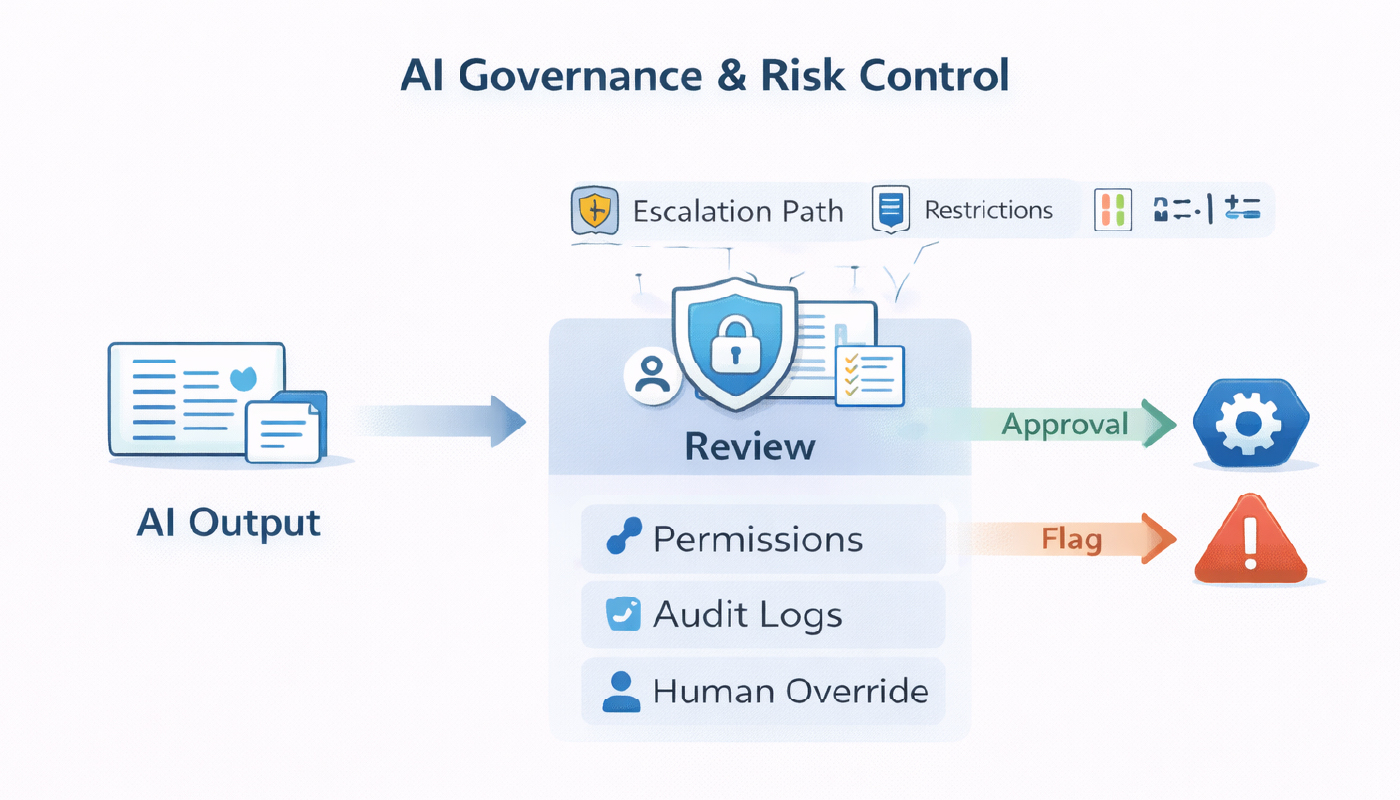
A business-ready AI tool should not just generate output. It should fit inside a controlled operating model.
That means asking:
- Is There An Approval Step Where Needed?
- Can We Review Output Before It Goes Live?
- Are There Logs, Permissions, And Admin Controls?
- Can We Restrict High-Risk Actions?
- Is There A Clear Escalation Path To a Human?
Google has added enhanced tool governance capabilities in Vertex AI Agent Builder, and Vertex AI Agent Engine also highlights governance controls for agents in production. Microsoft Foundry is being framed the same way, with governance and security built into the platform rather than treated as optional extras.
(This visual was created with AI assistance for illustrative and educational purposes.)
9. Check Vendor Lock-In And Exit Risk
This is one of the easiest things to miss during AI buying.
Before choosing a tool, ask:
- Can We Export Our Data?
- Can We Rebuild Key Workflows Elsewhere If Needed?
- Are Prompts, Automations, and Processes Portable?
- Are We Locked Into One Model or One Vendor’s Stack?
This matters more in 2026 because AI tools are becoming deeper parts of operations. Once a team builds real workflows around a vendor, switching becomes harder. That is why tool choice should include an exit strategy, not just a launch plan.
10. Do Not Ignore Adoption Risk
A technically powerful tool is still a poor choice if the team will not use it.
Warning signs include:
- Too Much Setup Friction
- Unclear Use Cases
- Steep Training Requirements
- Weak Documentation
- No Clear Internal Owner
- Workflow Disruption Without Visible Gain
This is one reason AI rollouts stall even after budget approval. A simpler tool with strong adoption is usually more valuable than a sophisticated platform nobody uses properly. If customer-facing adoption is part of the decision, it also helps to understand how AI is changing customer experience before choosing a support or service tool.
11. Use A Category-Based Decision Framework
Instead of asking which single AI tool is “best,” it is usually smarter to think in categories:
General Work And Team Productivity
Tools for drafting, summarizing, searching internal knowledge, and reducing repetitive work.
Workflow Automation
Tools that connect AI with the rest of your stack and reduce manual handoffs.
Customer Support And Service
Tools that handle repetitive queries, route tickets, summarize conversations, or support agents.
Sales And Lead Operations
Tools that prioritize leads, support qualification, improve handoff speed, and reduce CRM friction.
Enterprise AI Platforms
Tools and environments used to build governed AI systems, agents, or internal applications at scale.
This category-based view usually leads to better decisions than chasing whichever product is trending that week.
Final Selection Filter
Before choosing any AI tool, run it through this filter:
- Does It Solve A Real Problem We Already Have?
- Does It Fit The Tools We Already Use?
- Can The Team Adopt It Without Heavy Friction?
- Do We Have Clear Privacy And Governance Coverage?
- Can We Measure Whether It Saves Time, Money, Or Errors?
- Will It Still Make Sense As We Scale?
- Can We Exit Cleanly If It Stops Being The Right Fit?
That last question matters more than ever. AI tool selection is no longer about experimenting for the sake of experimentation. It is about operational fit.
Final Thoughts
The right AI tool is not the most impressive one. It is the one that fits your business clearly enough to remove friction, improve speed, and support the way your team already works.
That usually means:
- Starting With A Real Problem
- Checking Integrations Early
- Matching The Tool To Your Business Size
- Running A Pilot Before Rollout
- Defining ROI Before Expansion
- Taking Governance And Adoption Seriously
AI is not getting smaller as a business category in 2026. The noise around it is growing. That makes disciplined selection even more important.
A strong AI tool should make the business simpler, not more chaotic.