


Quick Takeaways
AI search optimization is about making content easy for search engines and AI answer systems to understand, trust, summarize, and cite. In 2026, content needs to work for both traditional search results and AI-driven experiences like AI Overviews, AI Mode, conversational search, and answer engines.
- Write Clear Answers Near The Top
- Cover Full Search Intent, Not Just One Keyword
- Add Original Insight, Examples, And First-Hand Value
- Use Reliable Sources For Important Claims
- Structure Content With Helpful Headings And FAQs
- Keep Internal Links Natural And Relevant
- Avoid Thin, Generic, Or Mass-Produced AI Content
Quick Answer: What Is AI Search Optimization?
AI search optimization is the process of creating content that can perform well in AI-powered search experiences. It focuses on clear answers, strong topic coverage, reliable sourcing, original examples, and content that helps users solve a real problem.
Traditional SEO still matters. Pages still need to be crawlable, indexable, useful, and technically strong. The difference is that AI search places greater emphasis on content that can clearly answer longer, more specific follow-up questions.
Google’s guidance on AI features in Google Search explains how AI Overviews and AI Mode work from a site owner’s perspective, including how content may appear in AI-powered search experiences.
Why AI Search Optimization Matters in 2026
Search is changing fast. Google’s AI Overviews and AI Mode have made search more conversational, more answer-led, and more layered. Users are no longer only typing short keywords. They are asking detailed questions, comparing options, and continuing with follow-up prompts.
In May 2026, Google announced new AI Mode and AI Overviews updates designed to help users find relevant websites, deeper insights, and original content from across the web. That update shows that AI search is not replacing web content, but it is changing how content gets surfaced, summarized, and clicked.
This shift also creates concerns for publishers. Reuters reported that Italy’s media regulator asked the EU to investigate Google’s AI-powered search tools after publisher concerns around AI search summaries, including possible traffic loss and risks to media pluralism.
For websites, the takeaway is clear: content needs to be easier to understand, easier to trust, and more useful than a generic summary. This connects directly with artificial intelligence in 2026 and how teams are using generative AI content workflows to improve content planning, structure, and review.
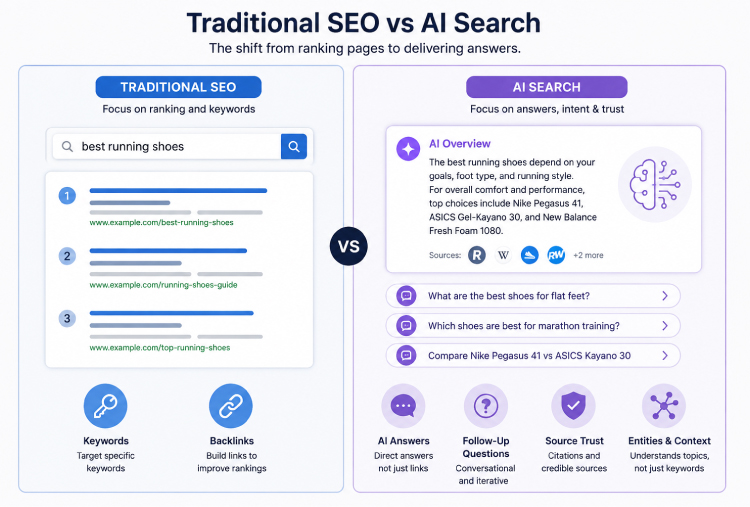
AI Search Optimization vs Traditional SEO
AI search optimization does not replace SEO. It builds on it.
Traditional SEO focuses on:
- Keywords
- Rankings
- Backlinks
- Page Speed
- Metadata
- Technical Indexing
- Search Intent
AI search optimization adds another layer:
- Clear Answers
- Entity Coverage
- Source Trust
- Structured Explanations
- Question-Based Formatting
- First-Hand Insight
- Extractable Facts
- Helpful Summaries
A traditional SEO article may rank because it targets the right keyword and satisfies user intent. An AI-search-ready article also helps AI systems understand what the content says, why it is trustworthy, and which part answers a specific user question.
(This AI-assisted visual is for illustrative and educational purposes only.)
1. Start With Search Intent, Not Keywords Alone
Keyword research still matters, but AI search is more intent-driven than keyword-driven.
Instead of only asking:
What keyword should this article target?
Ask:
- What Is The User Trying To Understand?
- What Follow-Up Questions Might They Ask?
- What Decision Are They Trying To Make?
- What Context Do They Need Before Acting?
- What Would A Complete Answer Include?
For example, a user searching for “AI search optimization” may also want to know:
- How AI Search Is Different From SEO
- How To Appear In AI Overviews
- How To Structure Content For AI Answers
- Whether AI Content Can Still Rank
- What Makes Content Trustworthy In AI Search
This is why semantic coverage matters. The best content does not just repeat the main keyword. It answers the full topic.
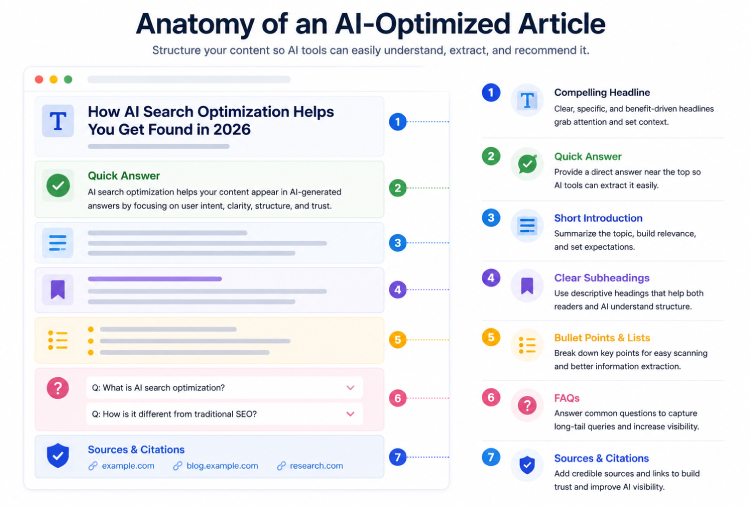
2. Put A Clear Answer Near The Top
AI-powered search experiences often summarize information quickly. That means your content should make the main answer easy to find.
A strong article should include:
- A Quick Answer
- A Short Definition
- A Clear Explanation Of The Main Topic
- A Summary Of What The Reader Will Learn
This does not mean writing shallow content. It means giving readers a direct answer first, then expanding with detail.
For example, instead of opening with a long history of search engines, an article on AI search optimization should quickly explain what it is, why it matters, and how users can improve visibility.
Clear answers help both readers and search systems understand the page faster.
(This AI-assisted visual is for illustrative and educational purposes only.)
3. Build Strong Topic Coverage
AI search systems work better with content that covers a topic clearly and completely.
For AI search optimization, strong topic coverage usually includes:
- Definitions
- Comparisons
- Examples
- Risks
- Best Practices
- Common Mistakes
- Tools
- FAQs
- Current Search Changes
If a page only answers one narrow angle, it may not be strong enough for broader AI search visibility. A better article covers the main question and the surrounding questions a user is likely to ask next.
This is where semantic SEO becomes essential. The goal is not keyword stuffing. The goal is meaningful coverage.
4. Add Original Insight And First-Hand Value
Generic content is easier to ignore. AI search has made this even more obvious because basic summaries are now easy to generate.
To stand out, content should include:
- Real Examples
- First-Hand Observations
- Practical Use Cases
- Screenshots Where Useful
- Clear Opinions
- Experience-Based Tips
- Original Comparisons
- Specific Recommendations
Google’s guidance on succeeding in AI search emphasizes unique, non-commodity content that visitors find helpful and satisfying. It also notes that users in AI search experiences ask longer and more specific questions, including follow-up questions.
That means AI-assisted content can work, but it needs human insight. If an article only repeats what already exists across search results, it is weaker.
5. Use Reliable Sources For Important Claims
AI search visibility depends heavily on trust. If your article includes statistics, regulations, technical claims, tool updates, or platform changes, source quality matters.
Use strong sources such as:
- Official Product Documentation
- Search Engine Documentation
- Regulatory Websites
- Research Reports
- Reputable News Sources
- Original Company Announcements
For example, if you are explaining Google AI search behavior, use Google Search Central or official Google product announcements. If you are discussing publisher concerns or regulation, use reputable news sources such as Reuters.
Avoid building important claims on weak round-up posts or unsourced statistics. AI search systems and readers both benefit from verifiable information.
6. Make Content Easy To Extract And Understand
AI search systems need to understand content structure. Readers do too.
Use:
- Descriptive Headings
- Short Paragraphs
- Clear Lists
- Direct Definitions
- Tables Where Useful
- FAQs
- Step-By-Step Sections
- Consistent Formatting
A good structure helps both humans and search systems identify the main answer, supporting details, and related subtopics.
For example, a section titled “AI Search Optimization vs Traditional SEO” is easier to understand than a vague heading like “What Changed?”
Clear headings improve scanability and context.
7. Use FAQs To Capture Follow-Up Questions
AI search experiences are conversational. Users often ask follow-up questions after the first answer.
That makes FAQs more important.
Strong FAQs should answer questions like:
- What Is AI Search Optimization?
- How Is AI Search Different From SEO?
- Can AI-Generated Content Appear In AI Search?
- How Do You Optimize For AI Overviews?
- Does Schema Help AI Search?
- What Makes Content Trustworthy For AI Answers?
FAQs should be concise but useful. They should not repeat the same content word-for-word from the article. Each answer should add clarity.
8. Keep AI-Generated Content Helpful And Reviewed
AI can help with content planning, outlines, summaries, and drafting. But publishing unreviewed AI content is risky.
Google’s documentation on using generative AI content says generative AI can be useful for research and structure, but using it to generate many pages without adding value may violate spam policies.
A strong AI-assisted content workflow should include:
- Human Strategy
- AI-Assisted Drafting
- Source Verification
- Original Examples
- Editorial Review
- SEO Review
- Final Quality Control
This is why AI search optimization connects closely with content quality. AI can speed up content, but it cannot replace accuracy, originality, and review.
9. Strengthen Internal Linking Around Topic Clusters
Internal linking helps users and search engines understand how your content connects.
For AI search optimization, useful internal links may connect to:
- AI Basics
- Generative AI Content
- AI Tools
- Voice Search
- Content Workflows
- SEO Strategy
The key is to link naturally. The anchor text should fit the sentence and help the reader move to a related topic.
For example, a section about conversational search can naturally connect to voice search optimization because both involve natural-language queries and user intent.
A section about tool selection can connect to AI tools for daily work without forcing the link.
10. Optimize For Entity-Based Search
AI search systems do not only look at keywords. They also interpret entities, relationships, and context.
Entities can include:
- People
- Companies
- Tools
- Frameworks
- Products
- Concepts
- Industries
- Regulations
For example, an article about AI search optimization may naturally mention:
- AI Overviews
- AI Mode
- Google Search Central
- Generative AI
- Semantic SEO
- Helpful Content
- Answer Engines
- Structured Data
- Voice Search
This helps build topical clarity. The article becomes easier to understand because it explains the topic through related concepts, not isolated keywords.
11. Keep Technical SEO Strong
AI search optimization still depends on the basics.
Your content should be:
- Crawlable
- Indexable
- Fast Loading
- Mobile-Friendly
- Properly Structured
- Free From Major Technical Errors
Google’s AI search guidance still points site owners back to core search fundamentals. If a page cannot be crawled, indexed, or understood, it will struggle in both traditional and AI search.
Technical SEO is no less important in 2026. It is the foundation that AI search optimization sits on. This is where Core Web Vitals still matter because page experience, speed, and usability affect how well content performs after it is found.
12. Use Schema Where It Makes Sense
Schema is not a magic shortcut to AI visibility, but it can help search engines understand page context.
Useful schema types may include:
- Article Schema
- FAQ Schema
- HowTo Schema
- Product Schema
- Organization Schema
- Review Schema
Use schema only when it matches the content. Do not add fake FAQ, review, or product markup just to chase visibility.
The goal is clarity, not manipulation.
13. Write For People Before AI Systems
AI search optimization should never make content feel robotic. If a page is hard for people to read, it is not truly optimized.
A people-first page should:
- Answer The Main Question Clearly
- Explain Concepts Simply
- Avoid Unnecessary Jargon
- Include Practical Examples
- Help The Reader Decide What To Do Next
- Avoid Keyword Stuffing
- Avoid Generic Filler
Google’s AI search direction still favors useful, satisfying content. The best optimization is to make the page genuinely helpful.
14. Track Performance Beyond Rankings
AI search makes performance tracking more complex. Traditional rankings still matter, but they do not tell the full story anymore.
Track:
- Organic Traffic
- Click-Through Rate
- Query Changes
- Engagement Time
- Assisted Conversions
- Branded Search Growth
- Featured Snippet Visibility
- AI Overview Visibility Where Available
AI search may change click patterns, but content can still support awareness, authority, leads, and conversions. That means content performance should be measured more broadly than position alone.
Common Mistakes In AI Search Optimization
Avoid these mistakes:
- Writing For AI Instead Of People
- Publishing Generic AI Drafts
- Ignoring Search Intent
- Using Weak Sources
- Skipping Internal Links
- Stuffing Keywords Into Headings
- Creating Thin FAQ Sections
- Repeating The Same Article From Competitors
- Ignoring Technical SEO
- Updating Titles Without Updating Content
AI search optimization is not about tricking AI systems. It is about making content more useful, clearer, and easier to trust.
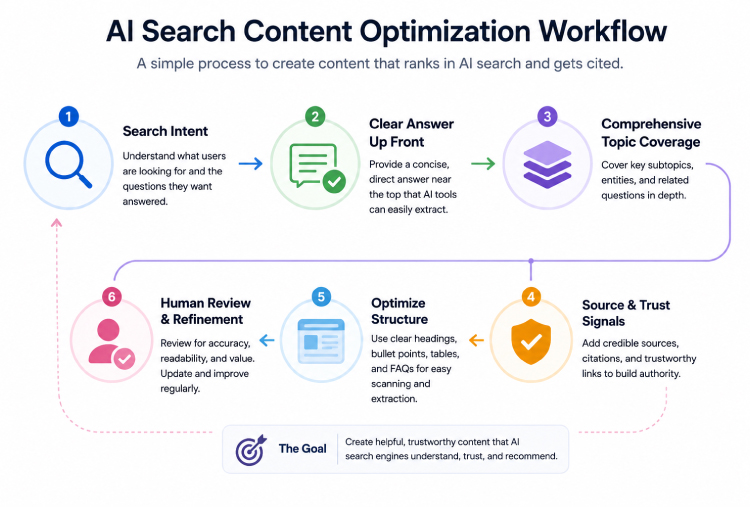
AI Search Optimization Checklist For 2026
Before publishing, check:
- Is The Main Answer Clear Near The Top?
- Does The Article Cover The Full Search Intent?
- Are Important Claims Supported By Reliable Sources?
- Does The Content Include Original Insight Or Examples?
- Are Headings Clear And Descriptive?
- Are Internal Links Natural And Relevant?
- Is The Page Technically Crawlable And Indexable?
- Are FAQs Useful And Non-Repetitive?
- Is The Content Better Than A Generic AI Summary?
- Has The Article Been Reviewed By A Human Editor?
(This AI-assisted visual is for illustrative and educational purposes only.)
FAQs About AI Search Optimization
What Is AI Search Optimization?
AI search optimization is the process of creating content that can perform well in AI-powered search experiences, including AI Overviews, AI Mode, conversational search, and answer engines.
Is AI Search Optimization Different From SEO?
Yes, but it builds on SEO. Traditional SEO focuses on rankings, keywords, links, and technical performance. AI search optimization adds clear answers, semantic coverage, source trust, entity clarity, and question-based structure.
How Do You Optimize Content For AI Answers?
Start with a clear answer, cover the topic fully, use reliable sources, add original examples, structure the page with strong headings, and include FAQs that answer follow-up questions.
Can AI-Generated Content Appear In AI Search?
Yes. AI-assisted content can perform if it is helpful, accurate, original, and reviewed. Low-value or mass-produced content created mainly to manipulate rankings is risky.
Do Backlinks Still Matter In AI Search?
Backlinks still matter as part of overall authority, but they are not the only factor. Content clarity, trust, topical relevance, usefulness, and technical accessibility also matter.
Does Schema Help With AI Search?
Schema can help search engines understand page context, but it is not a guaranteed path into AI answers. It should support accurate content, not replace it.
Final Thoughts
AI search optimization in 2026 is not about abandoning SEO. It is about improving content so it works in both traditional search and AI-driven answer systems.
The strongest content is clear, helpful, structured, source-backed, and original. It answers the main question quickly, explains the topic deeply, and gives readers something more useful than a generic summary.
As AI search continues to evolve, the websites that win will be the ones that focus on trust, clarity, and real value.







2 Responses
gulfarazahmed08@gmail.com
Informative!