
Quick Takeaways
AI governance is the system a business uses to control how AI is selected, approved, used, reviewed, monitored, and improved. In 2026, this matters because companies are no longer only using simple AI tools. They are using generative AI, workflow automation, and AI agents inside real business systems.
- Build An AI Use Inventory
- Classify AI Use Cases By Risk
- Set Clear Data And Privacy Rules
- Keep Human Review In High-Impact Workflows
- Monitor AI Outputs, Tool Actions, And Vendor Risk
- Train Employees On Safe And Responsible AI Use
- Review Governance Rules As AI Tools Change
Quick Answer: What Is AI Governance?
AI governance is the set of policies, controls, roles, and review processes that guide how a business uses artificial intelligence. It helps organizations manage risks such as data exposure, inaccurate outputs, bias, security issues, weak accountability, and uncontrolled automation.
In simple terms, AI governance answers five questions:
- Who Can Use AI?
- What Data Can Be Used?
- Which Tools Are Approved?
- Where Is Human Review Required?
- How Are Risks Tracked And Fixed?
This matters more in 2026 because AI is now part of content creation, customer support, internal reporting, sales operations, workflow automation, and agent-based systems. For a broader context, this connects directly to how artificial intelligence in 2026 is moving from standalone tools into connected business systems.
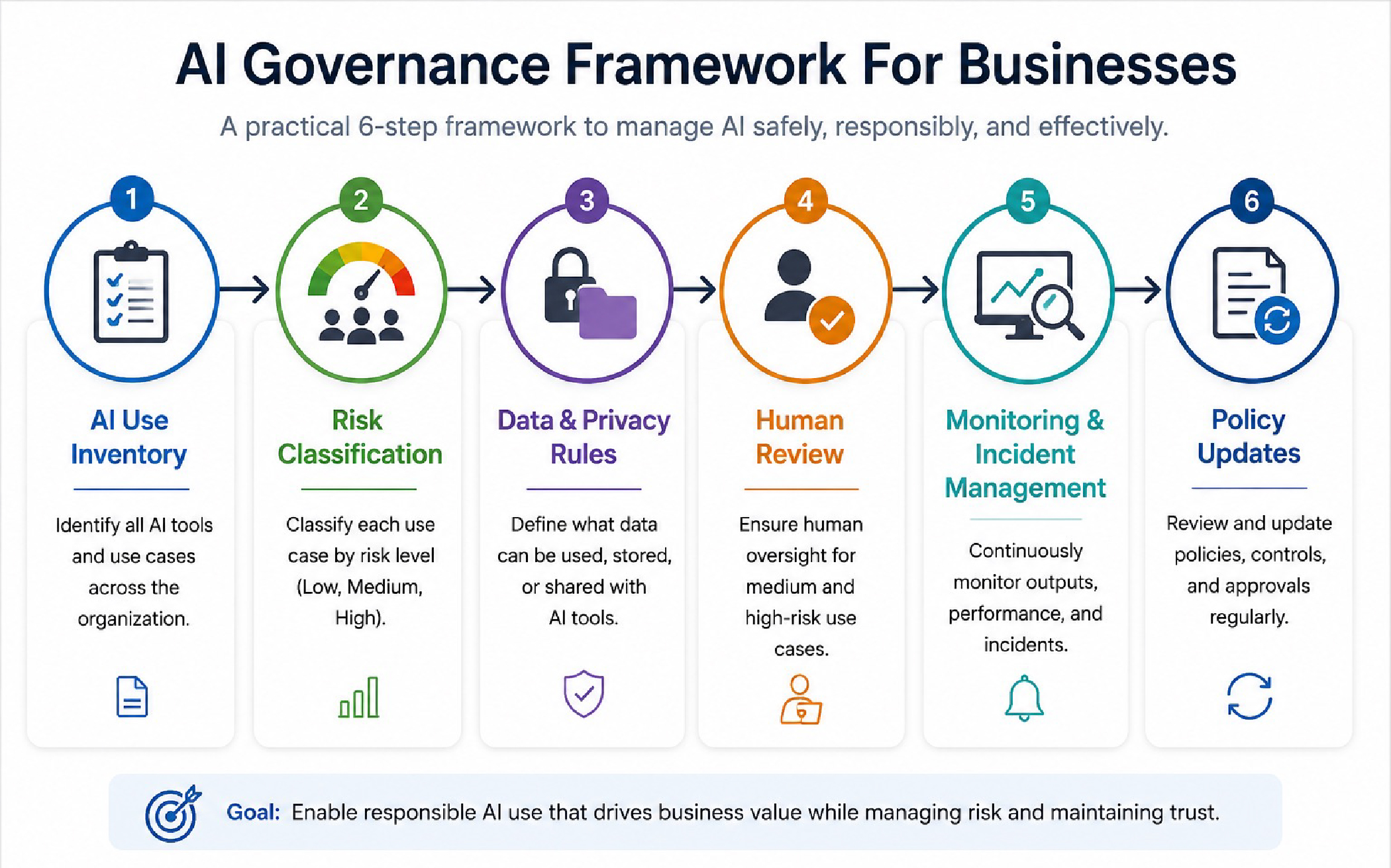
(This AI-assisted visual is for illustrative and educational purposes only.)
Why AI Governance Matters More in 2026
AI governance has moved from a legal or IT topic to a business-wide priority. Teams now use AI to write content, summarize documents, answer customer questions, score leads, analyze data, create reports, and support multi-step workflows. That creates value, but it also increases risk.
The main question is no longer only:
Can We Use AI?
It is now:
Can We Use AI Safely, Consistently, And Responsibly Across The Business?
The NIST AI Risk Management Framework is one of the most useful references for this shift. It helps organizations manage AI risks across people, organizations, and society through four core functions: Govern, Map, Measure, and Manage.
Regulation is also moving quickly. The EU AI Act entered into force on 1 August 2024, with obligations applying in phases. Official EU implementation guidance lists general provisions, AI literacy requirements, and prohibited practices applying from 2 February 2025; rules for general-purpose AI models applying from 2 August 2025; broader application from 2 August 2026; and extended timelines for some high-risk systems until 2 August 2027.
As of 2026, this timeline also needs close monitoring. Reuters reported that EU countries and lawmakers reached a provisional agreement that would delay the enforcement of some high-risk AI rules to 2 December 2027. Businesses affected by EU regulation should check official updates before making compliance decisions.
What AI Governance Covers
AI governance is not one policy document. It covers the full AI lifecycle, from choosing a tool to monitoring its performance after launch.
A strong AI governance system covers:
- AI Tool Selection
- Data Use And Privacy
- User Permissions
- Risk Classification
- Human Review
- Vendor And Third-Party Controls
- Output Monitoring
- Incident Response
- Employee Training
- Compliance Documentation
This is especially important when AI is connected to business systems. A content assistant that drafts outlines is lower risk than an AI agent that updates CRM records, sends customer messages, or handles financial workflows. Governance should match the level of risk.
1. Start With An AI Use Inventory
The first step in AI governance is knowing where AI is already being used.
Many companies underestimate how much AI is already inside their business. Employees may be using personal AI accounts, browser extensions, AI note-takers, writing assistants, design tools, CRM features, support bots, automation platforms, and analytics tools.
An AI use inventory should list:
- AI Tools Currently In Use
- Teams Using Each Tool
- Business Purpose
- Data Entered Into The Tool
- Vendor Or Platform Name
- Risk Level
- Owner Or Approver
- Review Status
This helps reduce shadow AI, which happens when employees use AI tools without approval, oversight, or clear data rules. Shadow AI is risky because sensitive information can be pasted into tools the company has not reviewed.
A useful governance rule is simple: if an AI tool touches customer data, employee data, financial information, legal content, internal strategy, or business records, it should be listed and reviewed.
2. Classify AI Use Cases By Risk
Not every AI use case needs the same controls. AI governance works best when use cases are grouped by risk level.
Low-Risk AI Use Cases
Low-risk AI use cases usually support basic productivity and do not involve sensitive data or high-impact decisions.
Examples:
- Brainstorming Ideas
- Summarizing Public Information
- Drafting Internal Notes
- Creating Basic Social Captions
- Formatting Non-Sensitive Documents
These still need basic rules, but they usually do not require heavy approval.
Medium-Risk AI Use Cases
Medium-risk AI use cases affect business quality, customer communication, or internal operations.
Examples:
- Drafting Customer Emails
- Creating Marketing Content
- Summarizing Internal Meetings
- Supporting Sales Follow-Ups
- Analyzing Non-Sensitive Business Data
These usually need human review before anything is sent, published, or acted on.
High-Risk AI Use Cases
High-risk AI use cases affect people, rights, compliance, finances, security, hiring, healthcare, legal decisions, or sensitive customer outcomes.
Examples:
- Automated Hiring Support
- Credit Or Financial Decisions
- Medical Or Health-Related Guidance
- Legal Review Or Compliance Decisions
- Fraud Detection
- Customer Eligibility Decisions
- AI Agents Taking Actions In Business Systems
The EU AI Act uses a risk-based approach, with stricter requirements for higher-risk systems. That makes risk classification a practical starting point for AI governance, even for businesses outside the EU that want stronger internal controls.
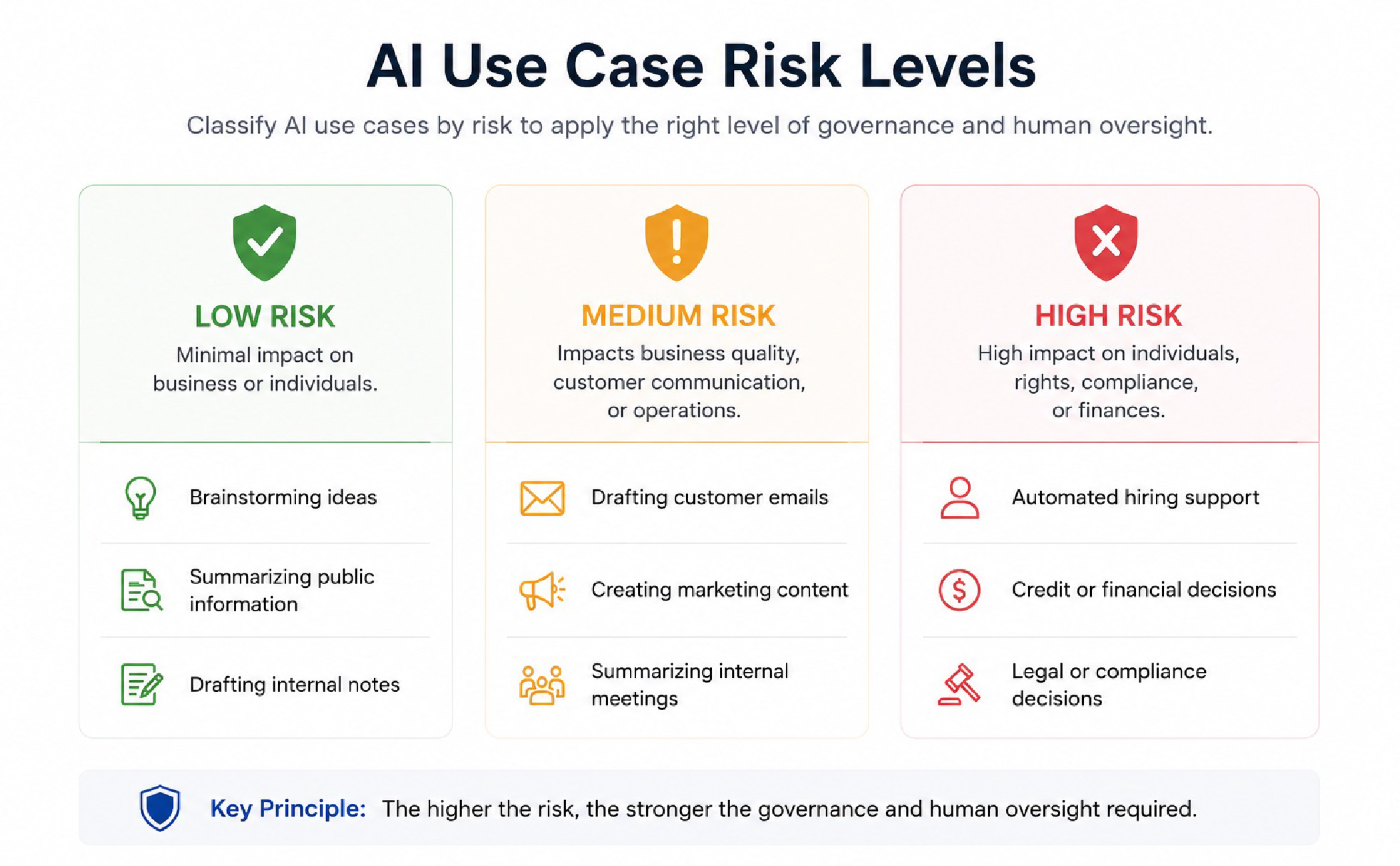
(This AI-assisted visual is simplified for educational purposes and should not be treated as legal or compliance advice.)
3. Set Clear Data And Privacy Rules
Data governance is one of the most important parts of AI governance. Teams need to know what they can and cannot enter into AI tools.
Your AI policy should define rules for:
- Customer Data
- Employee Data
- Financial Data
- Legal Documents
- Passwords And Credentials
- Internal Strategy Documents
- Confidential Client Information
- Health, Identity, Or Sensitive Personal Data
A good rule for employees is:
If The Data Would Not Be Safe In A Public Document, Do Not Paste It Into An Unapproved AI Tool.
Businesses also need to check whether vendors use customer inputs for model training. OpenAI’s business data privacy guidance states that business data from ChatGPT business products and the API is not used to train models by default. Vendor privacy terms like this should be reviewed before tools are approved.
This connects directly with AI data privacy, especially when teams use AI for customer support, analytics, internal documents, or client work.
4. Create An Approved AI Tools List
A strong governance system should make it easy for employees to know which tools are approved.
The approved AI tools list should include:
- Tool Name
- Approved Use Cases
- Approved Teams
- Data Restrictions
- Security Review Status
- Vendor Contact
- Renewal Or Review Date
This prevents teams from guessing. It also reduces the risk of employees using free or personal AI tools for sensitive business tasks.
The approved tools list should not stay fixed forever. AI tools change quickly, and vendors update features, privacy terms, integrations, and pricing. The list should be reviewed regularly.
If your team is still choosing tools, your article on the best AI tools for daily work can support the selection stage. Governance begins when the business decides how tools should actually be used.
5. Define Human Review Rules
Human review is one of the strongest controls in AI governance.
A business should clearly define when AI output needs human approval before use. This is especially important when AI affects customers, public content, legal decisions, financial processes, or internal records.
Human review should be required for:
- Customer-Facing Responses
- Published Content
- Legal Or Compliance Material
- Financial Or Pricing Recommendations
- HR Or Hiring Decisions
- High-Risk Customer Decisions
- AI Agent Actions In Business Systems
The safest structure is usually:
- AI Drafts, Human Approves
- AI Summarizes, Human Decides
- AI Flags, Human Reviews
- AI Routes, Human Escalates
- AI Suggests, Human Confirms
This is especially important for AI agents. When agents can take actions across tools, governance needs to control what actions are allowed, what actions require approval, and what actions should be blocked.
6. Build Governance Into AI Workflows
AI governance should not sit separately from daily work. It should be built into the workflow itself.
For example, if a support team uses AI to draft customer replies, the workflow should include:
- Approved Knowledge Sources
- Clear Escalation Rules
- Human Review For Sensitive Cases
- Logging Of AI-Assisted Replies
- Regular Quality Checks
- Feedback From Support Agents
If a sales team uses AI for lead scoring, governance should include:
- Clear Scoring Criteria
- Data Quality Checks
- Bias Review
- Human Override
- CRM Logging
- Performance Monitoring
That is why governance connects closely with AI workflow integration. AI becomes safer when controls are part of the process, not added after something goes wrong.
7. Manage AI Agent Risk Separately
AI agents need special governance because they can move beyond content generation and take actions. They may search systems, call tools, update records, route tasks, trigger notifications, or escalate cases.
AI agent governance should define:
- Which Tools Can the Agent Use
- Which Data Can the Agent Access
- Which Actions Need Approval
- Which Actions Are Blocked
- When The Agent Must Escalate
- How Outputs Are Logged
- How The Agent Can Be Disabled
Google Cloud’s update on tool governance in AI agents explains how administrators can manage which tools are available to developers inside Vertex AI Agent Builder. That reflects the direction enterprise AI is taking: agents are useful, but tool access needs control.
A simple rule works well: the more an AI system can do, the stronger the governance should be.
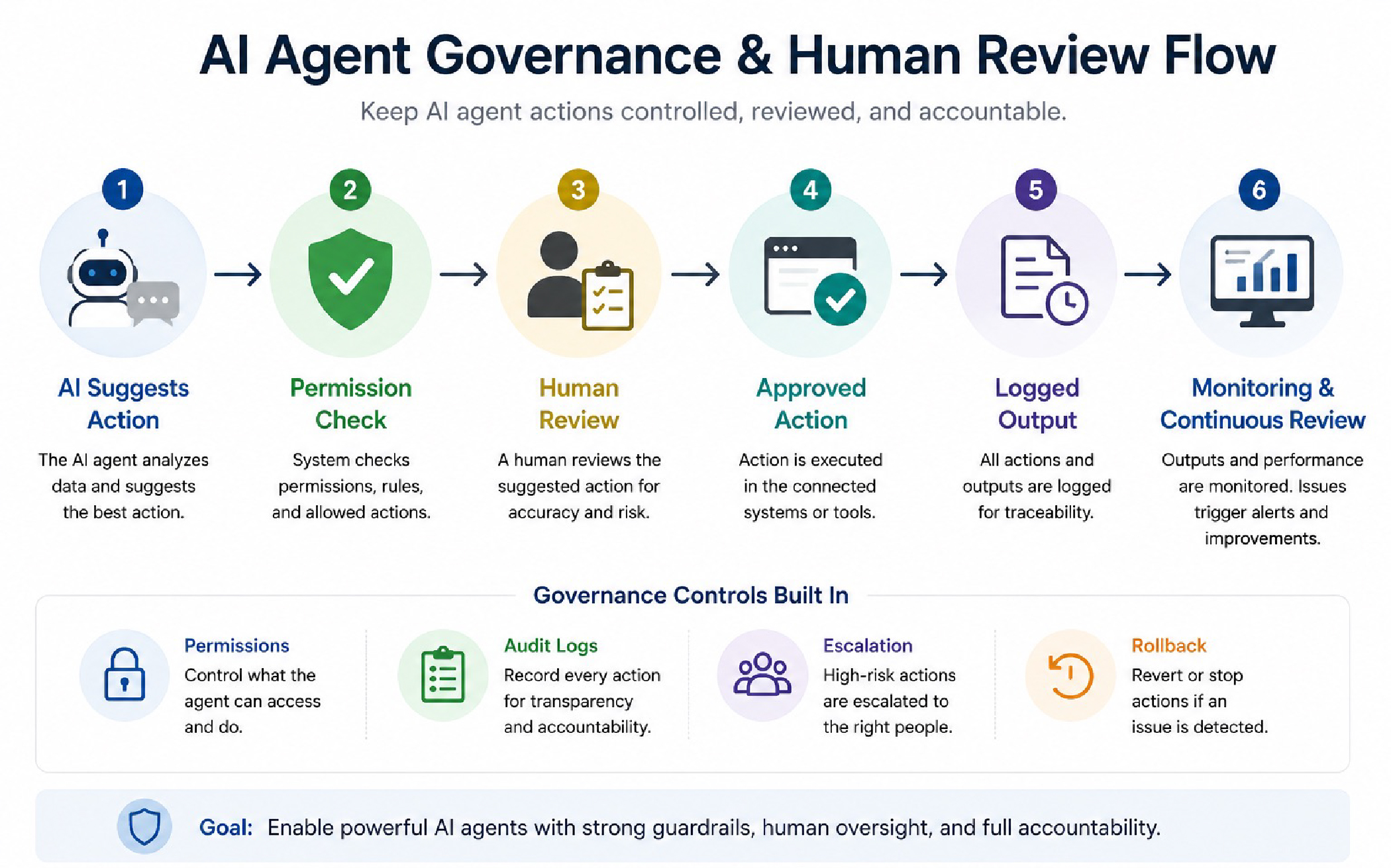
(This AI-assisted visual is for educational purposes only. Governance steps shown are simplified and should not replace legal, compliance, or security guidance.)
8. Align With Major AI Governance Frameworks
Businesses do not need to follow every framework at once. Knowing the main frameworks helps teams build a stronger governance system.
NIST AI Risk Management Framework
The NIST AI Risk Management Framework is one of the most practical starting points. It focuses on helping organizations manage AI risk through four functions: Govern, Map, Measure, and Manage.
It is especially useful for companies that want a structured internal risk process without starting from a legal-only approach.
NIST Generative AI Profile
NIST also published a Generative AI Profile for the AI Risk Management Framework. It helps organizations think about risks across the generative AI lifecycle, including synthetic content, hallucinations, data concerns, and misuse.
This is useful for teams using AI to create content, support customers, write code, summarize documents, or power internal assistants.
ISO/IEC 42001
ISO/IEC 42001 is the world’s first AI management system standard. ISO describes it as a structured way to manage AI risks and opportunities, including transparency, ethics, and continuous learning.
This is especially useful for organizations that want a formal AI management system, similar to how some businesses use ISO standards for security, quality, or privacy management.
EU AI Act
The EU AI Act matters for businesses operating in or serving the EU, especially those using high-risk AI systems or general-purpose AI models. The Act uses a risk-based approach, with different obligations depending on the system and use case.
As of 2026, businesses should track both official EU implementation pages and current legislative updates. Reuters has reported a provisional agreement that would delay enforcement of some high-risk AI rules, but organizations should verify final obligations against official EU sources before changing compliance plans.
OECD AI Principles
The OECD AI Principles promote trustworthy AI that respects human rights and democratic values. The principles were first adopted in 2019 and updated in May 2024 to reflect newer technology and policy developments.
They are useful for businesses that want governance principles around fairness, transparency, accountability, safety, and human-centered AI.
9. Write A Practical AI Use Policy
An AI policy should be clear enough for employees to follow. It should not be a vague statement about responsible AI.
A practical AI use policy should cover:
- Approved Tools
- Prohibited Tools
- Data Employees Cannot Enter
- Use Cases That Need Approval
- Human Review Requirements
- Content Disclosure Rules
- Customer Communication Rules
- Security And Access Rules
- Incident Reporting
- Consequences For Misuse
The policy should also include simple examples.
For example:
- Allowed: Using AI To Draft A Non-Sensitive Internal Meeting Summary
- Needs Review: Using AI To Draft A Customer Response
- Not Allowed: Uploading Customer Records To An Unapproved AI Tool
- High-Risk: Using AI To Make Hiring Or Financial Decisions Without Human Review
The goal is clarity. Employees should not have to guess what safe AI use looks like.
10. Train Employees On AI Literacy
AI literacy is now part of governance. Teams need to understand what AI can do, where it fails, and when human judgment matters.
Training should cover:
- How AI Tools Work At A Basic Level
- Common AI Risks
- Data Privacy Rules
- Prompting Basics
- Fact-Checking Outputs
- Bias And Fairness
- Human Review Requirements
- Approved Tools And Use Cases
- How To Report AI Issues
The EU AI Act includes AI literacy obligations that began applying from 2 February 2025, which reflects how important employee training has become in AI governance.
Training should not be one long session once a year. Short, practical sessions by team or workflow usually work better.
11. Monitor Outputs And Incidents
AI governance does not stop after a tool is launched. Businesses need to monitor how AI performs over time.
Monitoring should include:
- Accuracy Checks
- Error Patterns
- User Complaints
- Escalation Volume
- Sensitive Data Exposure
- Bias Or Fairness Concerns
- Security Alerts
- Hallucinated Outputs
- Vendor Changes
Teams should also define what counts as an AI incident.
Examples:
- AI Sends Incorrect Customer Information
- AI Uses Sensitive Data Incorrectly
- AI Produces Biased Or Harmful Output
- AI Agent Takes An Unauthorized Action
- AI Tool Exposes Confidential Information
- AI Content Publishes An Unverified Claim
Each incident should have an owner, review process, and corrective action.
12. Review Vendors And Third-Party AI Risk
AI governance must include vendor risk. Many businesses use AI through third-party tools, not internal models.
Before approving a vendor, ask:
- What Data Does The Vendor Collect?
- Is Customer Data Used For Model Training?
- Where Is Data Stored?
- What Security Certifications Exist?
- Are Admin Controls Available?
- Can Data Be Exported Or Deleted?
- Are Audit Logs Available?
- What Happens If The Vendor Changes Terms?
Vendor review matters because an AI tool can become deeply embedded in daily workflows. Governance should also consider exit risk, not just launch convenience.
13. Add Disclosure Rules For AI Content And Visuals
Not every AI use needs a public disclosure, but some use cases benefit from transparency.
Disclosure may be useful when AI is used for:
- AI-Generated Images
- AI-Assisted Reports
- Customer-Facing Summaries
- Synthetic Media
- Research Summaries
- Educational Visuals
- Public Content Created With Heavy AI Assistance
Simple disclosure lines work best:
- This Visual Was Created With AI Assistance For Illustrative Purposes
- This Dashboard Is An AI-Generated Sample And Does Not Represent Real Data
- This Content Was Drafted With AI Assistance And Reviewed By A Human Editor
This is especially relevant for content teams using generative AI content workflows, where visuals, drafts, and summaries may involve AI support.
14. Create An AI Governance Owner Or Committee
AI governance needs ownership. Without ownership, policies become documents nobody follows.
Depending on business size, the owner may be:
- IT Lead
- Security Lead
- Legal Or Compliance Lead
- Operations Lead
- Data Governance Lead
- Cross-Functional AI Committee
The owner or committee should manage:
- AI Tool Approvals
- Policy Updates
- Risk Reviews
- Training
- Incident Response
- Vendor Reviews
- High-Risk Use Case Decisions
For small businesses, this does not need to be formal or complicated. One responsible owner is better than no ownership at all.
AI Governance Checklist For 2026
Before rolling out AI across the business, check:
- Do We Have An AI Use Inventory?
- Are AI Use Cases Classified By Risk?
- Do Employees Know Which Tools Are Approved?
- Are Sensitive Data Rules Clear?
- Is Human Review Required For High-Impact Outputs?
- Are AI Agent Actions Controlled?
- Are Vendors Reviewed Before Approval?
- Are Employees Trained On Safe AI Use?
- Do We Track AI Errors And Incidents?
- Is There A Clear Owner For AI Governance?
- Are Policies Reviewed Regularly?
Common AI Governance Mistakes
Avoid these mistakes:
- Letting Teams Use Any AI Tool Without Review
- Creating A Policy That Nobody Understands
- Treating AI Governance As Only An IT Issue
- Ignoring Shadow AI
- Skipping Employee Training
- Allowing Sensitive Data In Unapproved Tools
- Using AI For High-Risk Decisions Without Human Review
- Forgetting Vendor Risk
- Not Logging AI Agent Actions
- Failing To Update Policies As Tools Change
Most AI governance failures are not caused by one bad tool. They happen because the business had no clear rules, no owner, and no review process.
FAQs About AI Governance For Businesses
What Is AI Governance In Business?
AI governance is the set of policies, controls, roles, and processes a business uses to manage AI safely and responsibly. It covers tool approval, data use, human review, monitoring, vendor risk, and compliance.
Why Is AI Governance Important In 2026?
AI governance matters in 2026 because AI is now used in business workflows, customer communication, content creation, internal reporting, and agent-based automation. Without governance, businesses face higher risks around privacy, accuracy, bias, security, and accountability.
What Should An AI Governance Policy Include?
An AI governance policy should include approved tools, prohibited uses, data restrictions, human review rules, high-risk use cases, vendor review, disclosure rules, training requirements, and incident reporting.
Do Small Businesses Need AI Governance?
Yes. Small businesses may not need a large committee or complex framework, but they still need clear rules for approved tools, sensitive data, human review, and safe use.
What Is The Best AI Governance Framework?
There is no single best framework for every business. NIST AI RMF is a strong starting point for risk management, ISO/IEC 42001 is useful for formal AI management systems, and the EU AI Act matters for businesses affected by EU regulation.
How Often Should AI Policies Be Reviewed?
AI policies should be reviewed at least every few months or whenever a major tool, workflow, vendor, or regulatory requirement changes. Fast-moving AI use cases need regular review.
Final Thoughts
AI governance in 2026 is not about blocking AI use. It is about making AI safer, clearer, and more useful across the business.
The strongest governance systems do three things well:
- They Show Teams What Is Allowed
- They Protect Sensitive Data And High-Impact Decisions
- They Keep Humans Accountable Where Judgment Matters
Businesses that build governance early will be better prepared for AI tools, generative AI, AI agents, new regulations, and future automation. The goal is simple: use AI confidently without losing control.