
Quick Takeaways
Generative AI can speed up content planning, drafting, editing, and repurposing, but it should not replace strategy, accuracy checks, or human judgment. In 2026, the strongest AI-assisted content is useful, original, accurate, well-structured, and reviewed before publishing.
- Use AI To Support Strategy, Not Replace It
- Add Original Insight, Experience, And Examples
- Fact-Check Every Important Claim Before Publishing
- Keep Brand Voice And Audience Intent Clear
- Avoid Scaled, Low-Value AI Content
- Protect Private, Customer, And Internal Data
- Build A Repeatable Human Review Workflow
(This visual was created with AI assistance for illustrative and educational purposes.)
Why Generative AI Content Needs A Better Process In 2026
Generative AI is now a normal part of content workflows. HubSpot’s 2026 marketing data reports that 80% of marketers use AI for content creation, showing how quickly AI-assisted writing has moved from experimentation into daily marketing work.
But wider use also creates more risk. AI can help teams create outlines, briefs, social posts, scripts, summaries, and first drafts. It can also create generic, inaccurate, repetitive, or low-value content when teams use it without a clear process.
Google’s guidance on AI-generated content makes an important point: using AI is not automatically a problem. The issue is whether the content is helpful, reliable, and created for people instead of search manipulation. Google’s documentation on using generative AI content also warns that producing many pages without adding value may violate scaled content abuse policies.
That means businesses should not treat generative AI as a shortcut to publish more. It should be part of a controlled content workflow that improves speed while protecting quality. For a broader context, this connects naturally with artificial intelligence in 2026 and the current AI tools for daily work.
1. Start With Search Intent Before Using AI
The biggest mistake is asking AI to write before the content goal is clear.
Before drafting, define:
- Target Audience
- Main Search Intent
- Primary Question
- Reader’s Current Problem
- Content Type Needed
- Next Action The Reader Should Take
A product comparison needs a different structure than a tutorial. A thought-leadership article needs a different voice than a product review. A landing page needs a different flow than a blog post.
AI can generate text quickly, but it cannot replace a clear content strategy. The prompt should come after the plan, not before it.
2. Use AI For Drafting, Not Final Publishing
Generative AI is useful for turning rough ideas into a starting draft. It is not reliable enough to publish without review.
Use AI for:
- Topic Angles
- Content Briefs
- First Drafts
- Subheading Variations
- FAQ Ideas
- Summary Sections
- Repurposing Long Content Into Shorter Formats
Keep humans responsible for:
- Accuracy
- Originality
- Final Structure
- Brand Voice
- Expert Insight
- Publishing Approval
This matters most in business, finance, health, legal, software, SEO, and technical topics. The more a reader may rely on the content to make a decision, the more human review matters.
3. Add Original Insight And First-Hand Value
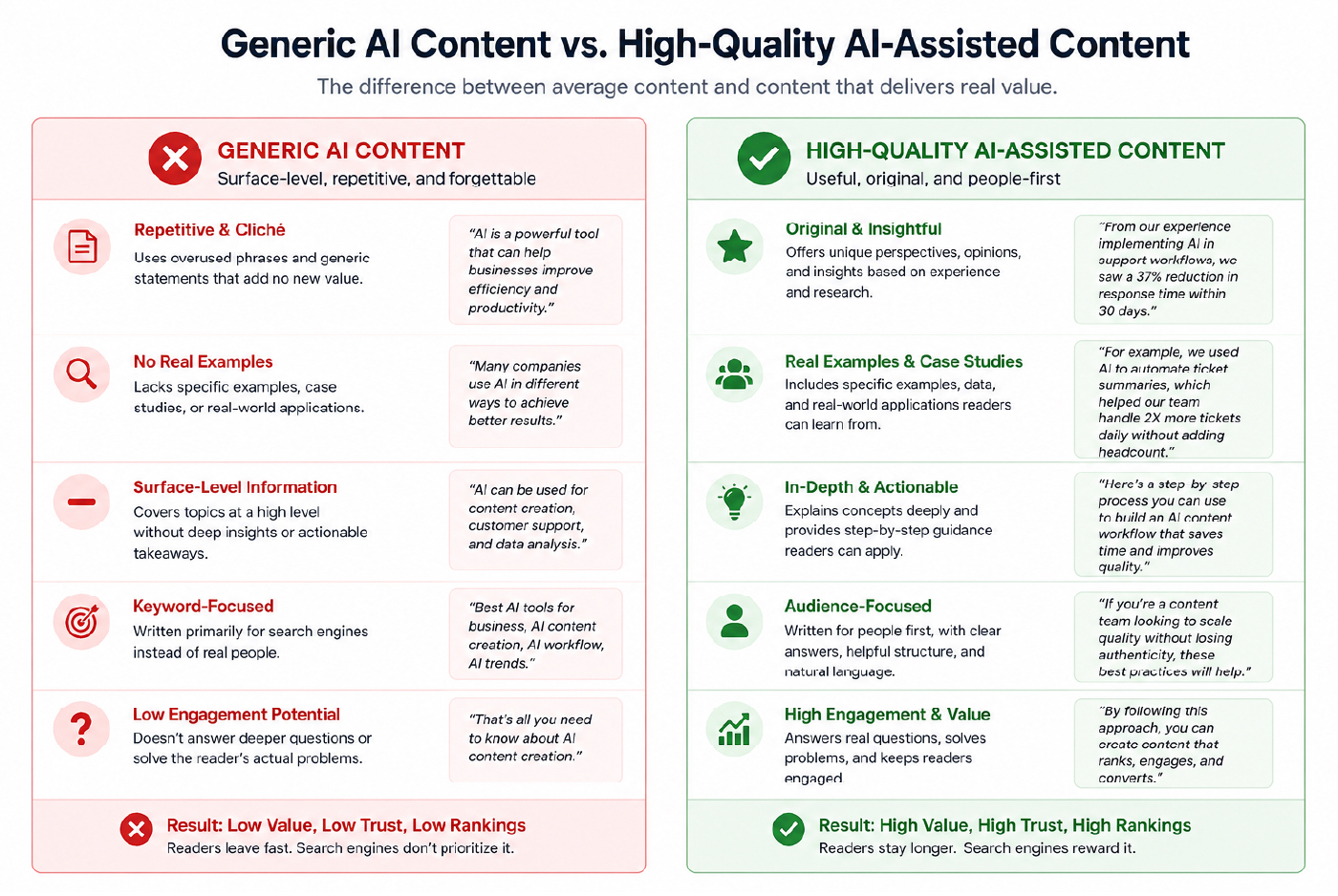
AI-generated content often sounds polished, but it can still feel empty. That usually happens when an article only repeats information already found across search results.
To make AI-assisted content stronger, add:
- Real Examples
- Brand-Specific Opinions
- Customer Questions
- Internal Lessons
- Screenshots Or Process Notes
- First-Hand Experience
- Clear Recommendations
Google’s guidance on helpful, people-first content emphasizes usefulness, reliability, and content created to benefit people. In practice, that means your article should give readers something more useful than a generic summary.
For example, instead of saying “AI can help with customer support,” a stronger section would explain how a support team uses AI to summarize tickets, route urgent cases, draft first replies, and keep human escalation for complex issues. That level of detail makes content more credible.
(This visual was created with AI assistance for illustrative and educational purposes.)
4. Fact-Check Every Important Claim
Generative AI can sound confident even when it is wrong. That is one of the biggest risks in AI-assisted content production.
Before publishing, verify:
- Statistics
- Dates
- Product Features
- Tool Names
- Pricing Claims
- Legal Or Compliance Details
- Medical, Financial, Or Technical Statements
- Quotes Or Attributions
Use primary or trusted sources wherever possible. For search, SEO, and technical claims, prioritize official documentation, product pages, research reports, and recognized industry sources.
A simple rule works well: if a claim affects trust, money, safety, compliance, or a buying decision, verify it before publishing.
5. Avoid Scaled AI Content Without Added Value
Publishing more content does not automatically create more authority. In 2026, scaled low-value AI content is one of the riskiest content strategies.
Google’s spam policies define scaled content abuse as producing many pages primarily to manipulate rankings instead of helping users. That can happen with AI-generated content, human-written content, or any other production method.
Avoid content that is:
- Thin
- Repetitive
- Unoriginal
- Over-Optimized
- Built Only Around Keywords
- Missing Real Insight
- Published Without Review
A safer strategy is to publish fewer, stronger pieces that answer real questions, include useful detail, and connect to a clear topic cluster.
6. Build A Human Review Workflow
AI-assisted content needs a repeatable review process, especially if multiple people are involved.
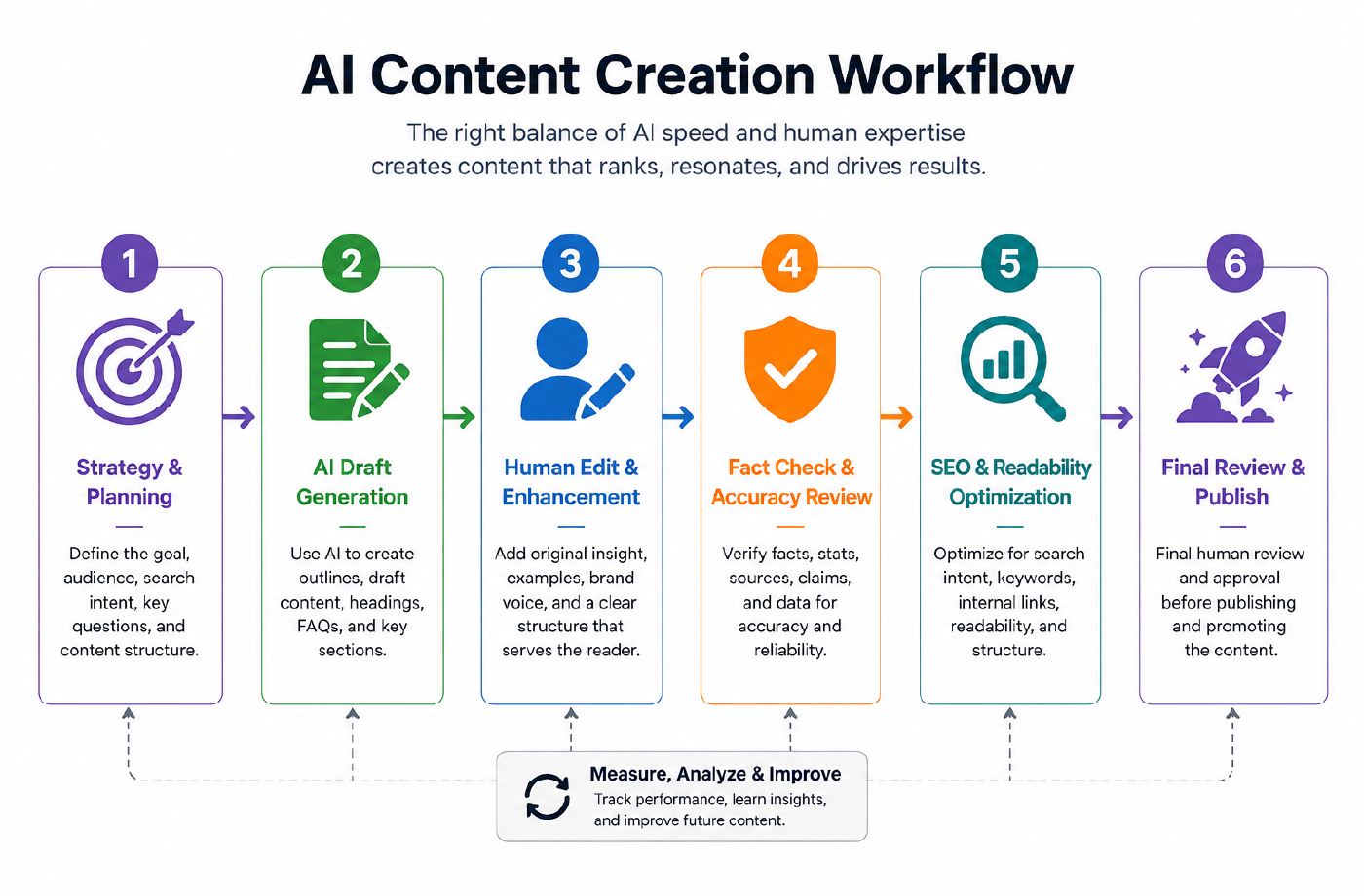
A strong workflow looks like this:
- Strategist Defines The Intent
- AI Helps Build The Draft
- Writer Adds Insight And Structure
- Editor Checks Flow And Voice
- Specialist Reviews Accuracy
- SEO Lead Checks Links And Search Intent
- Final Reviewer Approves Before Publishing
This does not have to be complicated. For a small team, one person may cover several roles. The point is to separate drafting from approval.
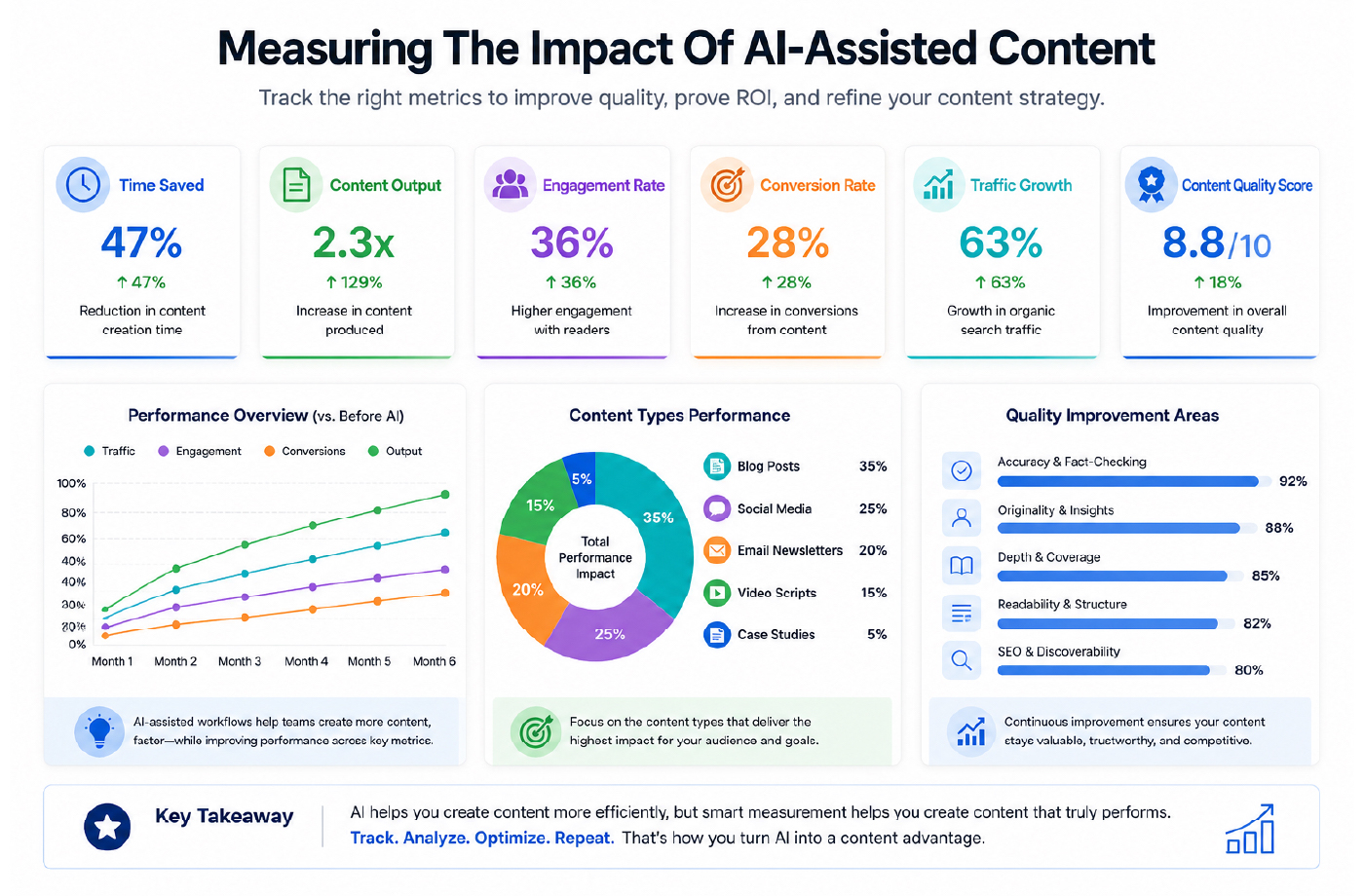
This connects closely with AI workflow integration, where the strongest results usually come from clear ownership, repeatable steps, and measurable outcomes.
(This dashboard is an AI-generated sample for illustrative purposes only and does not represent real data.)
7. Keep Brand Voice Consistent In AI-Generated Content
One common AI content problem is that everything starts sounding the same. That happens when the tool is given vague prompts and no brand rules.
Before using AI regularly, define:
- Tone
- Reading Level
- Formatting Rules
- Words Or Phrases To Avoid
- CTA Style
- Strong Brand Examples
- Examples That Do Not Fit The Brand
A brand voice guide makes AI outputs easier to edit and more consistent. It also reduces the risk of publishing content that sounds robotic, generic, or disconnected from the audience.
For teams using AI across blogs, emails, social posts, product pages, and scripts, voice control becomes more important than prompt creativity.
8. Use AI To Improve Structure, Not Just Volume
Generative AI can help make content easier to read when it is used well.
Use AI to improve:
- Heading Order
- FAQ Coverage
- Summary Sections
- Table Structures
- Step-By-Step Flow
- Comparison Sections
- Shorter Paragraphs
- Clearer Definitions
This is useful for long-form articles and guides. AI can help identify where readers may get confused, where a transition feels weak, or where a topic needs a quick answer before a deeper explanation.
The goal is not just faster writing. The goal is easier reading.
9. Protect Data, Privacy, And Confidential Information
Do not paste private business information, customer records, internal strategy documents, financial data, or sensitive client material into AI tools without understanding how that data is handled.
Before using AI in a content workflow, ask:
- What Data Are We Entering?
- Is It Customer Or Internal Data?
- Can The Vendor Use It For Training?
- Are We On A Business Or Personal Plan?
- Who Can Access The Outputs?
- Do We Need Admin Controls Or Data Retention Settings?
OpenAI’s business data privacy materials state that business data from business products and the API is not used for training by default. That type of vendor policy matters when AI is used for client work, customer communications, or internal content production.
This also connects naturally with AI and data privacy because content teams often handle internal documents, client notes, research, and customer-facing material.
10. Use AI For Repurposing, But Keep Context Intact
Repurposing is one of the strongest uses of generative AI.
A long article can become:
- LinkedIn Posts
- Newsletter Sections
- Short Video Scripts
- Carousel Copy
- FAQ Blocks
- Email Sequences
- Sales Enablement Notes
But repurposing should not flatten the message. A blog section rewritten for LinkedIn should sound like a post. A technical guide turned into a video script should sound natural when spoken. A newsletter version should lead with the point the audience cares about most.
For example, a webinar can become a blog summary, three LinkedIn posts, one email newsletter, and five short video talking points. AI can draft the variations, but a human should still check the hook, accuracy, tone, and platform fit.
11. Add Clear Disclosures When Needed
Not every use of AI needs a large disclaimer. But transparency matters when AI creates visuals, summaries, research support, or customer-facing assets where readers may reasonably want to know how the content was produced.
Useful disclosure examples:
- This Visual Was Created With AI Assistance For Illustrative Purposes
- This Article Was Drafted With AI Assistance And Reviewed By A Human Editor
- AI Was Used To Support Research Organization And Content Structuring
Keep disclosures simple and factual. Do not over-explain. Do not make them sound like an apology.
12. Optimize For AI Search And Traditional Search
Search is changing. AI Overviews, AI Mode, conversational search, and answer engines are changing how users find information. That does not mean SEO is dead. It means content needs to be clearer, more useful, and easier to interpret.
Strong AI-search-ready content usually has:
- Clear Answers Near The Top
- Specific Examples
- Natural Questions And Answers
- Strong Topic Coverage
- Reliable Sources
- Internal Links To Related Content
- Original Insight
- Clear Author Or Brand Accountability
Google’s guidance on succeeding in AI search points toward unique, satisfying content that answers more specific and follow-up style queries. That fits well with semantic SEO because the goal is not just to repeat keywords. The goal is to cover the topic in a way that helps users make sense of it.
AI search is also changing how publishers think about visibility. In 2026, Reuters reported that the European Publishers Council filed an EU antitrust complaint over Google’s AI-generated summaries, which shows how actively AI search is reshaping content discovery and publisher traffic concerns.
13. Keep Internal Links Natural
Internal links should help readers move through the topic, not interrupt them.
A strong generative AI content article can naturally connect to:
- The Pillar AI Guide
- Best AI Tools
- AI Workflow Integration
- AI Business Strategy
- AI Data Privacy
- Customer Experience
- Generative AI Trends
The link should sit on a relevant phrase, not a full article title forced into a sentence. This keeps the reading flow clean and strengthens topical authority.
A good example is linking a phrase like generative AI trends inside a sentence about how the technology is changing content production.
14. Use AI To Refresh Old Content
AI can be useful for content updates, especially when paired with human review.
Use AI to help identify:
- Outdated Dates
- Old Tool Names
- Broken Logic
- Missing Sections
- Weak Headings
- Thin FAQs
- Repetitive Paragraphs
- Internal Linking Gaps
Then let a human editor decide what actually changes. This is especially useful for fast-moving topics like AI tools, SEO, cybersecurity, software, and digital marketing.
A refreshed article should not simply add “2026” to the title. It should update the facts, structure, search intent, examples, sources, and links.
Generative AI Content Checklist For 2026
Before publishing AI-assisted content, check:
- Is The Search Intent Clear?
- Does The Content Add Original Value?
- Has Every Important Claim Been Verified?
- Does The Content Match Brand Voice?
- Are Sources Relevant And Current?
- Are Internal Links Natural?
- Is There Human Review Before Publishing?
- Does The Article Help A Real Reader?
- Is The Content Better Than A Generic AI Summary?
Common Mistakes To Avoid
Avoid these mistakes when using generative AI for content:
- Publishing AI Drafts Without Editing
- Creating Too Many Similar Articles
- Using AI To Rewrite Competitor Content
- Adding Stats Without Checking Sources
- Ignoring Brand Voice
- Overusing Generic Intros
- Stuffing Keywords Into Awkward Sentences
- Skipping Human Review
- Pasting Sensitive Business Data Into Personal AI Tools
These are the habits that make AI content weak, risky, or forgettable.
FAQs About Generative AI Content
Can AI-Generated Content Rank On Google?
Yes. Google does not automatically reject content because AI was used. The key issue is whether the content is helpful, reliable, original, and created for people rather than search manipulation.
Is AI Content Bad For SEO?
AI content is not automatically bad for SEO. Low-quality, generic, scaled, or unreviewed content is the problem. AI-assisted content can support SEO when it includes original insight, accurate information, and strong human editing.
Should Businesses Disclose AI-Generated Content?
It depends on how AI was used and what the content is for. Simple drafting assistance may not need a large disclosure. AI-generated visuals, summaries, or customer-facing assets may benefit from a short, clear note.
What Is The Best Way To Use Generative AI For Content?
The best use is as part of a workflow: strategy first, AI-assisted draft second, human review third, and final quality control before publishing.
How Can Teams Avoid Generic AI Content?
Teams can avoid generic AI content by adding first-hand examples, brand perspective, customer questions, expert review, source-backed facts, and clear recommendations.
Final Thoughts
Generative AI can make content production faster, but speed is not the real advantage. The real advantage comes when AI helps teams plan better, structure better, repurpose smarter, and reduce repetitive drafting work without lowering quality.
The strongest AI-assisted content in 2026 is not fully automated. It is guided by strategy, improved by human insight, checked for accuracy, and written for real readers.
That is how generative AI becomes a content advantage instead of a content risk.