
Your personal data is everywhere: in your phone, on cloud servers, and flowing through apps you barely think about. Protecting it used to mean firewalls and passwords. Today, it increasingly means Artificial Intelligence (AI), which is becoming one of the strongest allies in data privacy.
Let’s explore how AI enhances privacy, the tools behind it, and where the risks still lie. Let’s take a deep dive into how AI Improves Data Privacy and protection?
Why AI Is a Game Changer for Data Privacy
Traditional privacy safeguards often struggle against the scale of modern data. Hackers move fast, regulations change, and sensitive information flows across borders. AI steps in by:
- Spotting anomalies in real time: Algorithms learn what “normal” behavior looks like and flag odd access patterns or leaks before humans notice.
- Automating compliance: AI tools can detect personally identifiable information (PII) and apply encryption or redaction instantly.
- Scaling protection: Whether it is millions of medical records or billions of social media posts, AI handles volume with speed.
For example, security teams use AI-powered behavioral analytics to detect when an employee account behaves strangely, such as logging in from two countries within an hour. That is a red flag that old security systems might miss. Learn more How to Use AI to Enhance Data Privacy: Tools and Techniques
Source: https://www.scalefocus.com/blog/how-to-address-generative-ai-data-privacy-concerns
Key Privacy-Enhancing Tech That AI Enables
AI is not just a theory. It powers several privacy-enhancing technologies (PETs) you will hear more about in 2025 and beyond.
Differential Privacy
Adds mathematical “noise” to datasets so individuals cannot be re-identified, while still keeping group patterns useful. Apple enhances its features like Genmoji using this method (Apple Machine Learning Research). The U.S. Census Bureau also applies “disclosure avoidance” techniques, a form of differential privacy (Census.gov).
Federated Learning
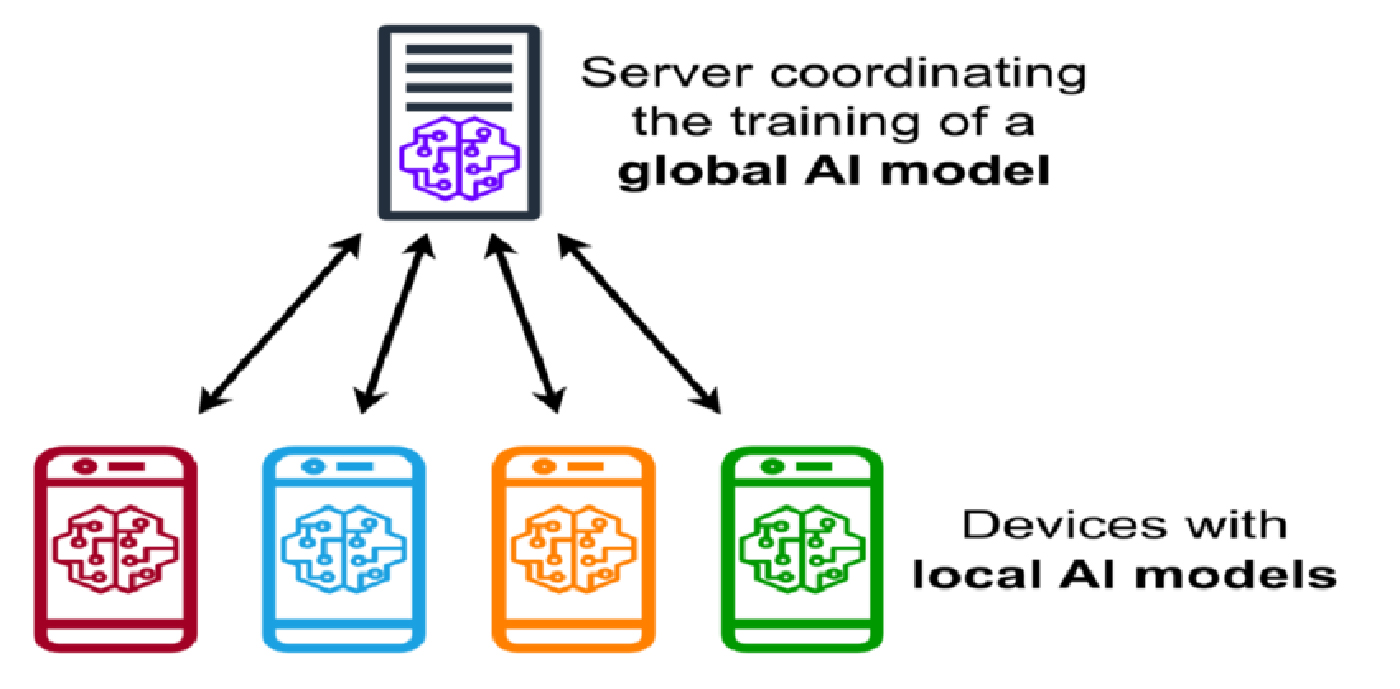
Instead of pulling everyone’s data into one central server, the model trains locally on your device. Only model updates are shared. Google explains this well in its AI blog (Google Research). This protects raw data while advancing AI accuracy.
Source: https://en.wikipedia.org/wiki/Federated_learning
Synthetic Data
Creates fake but statistically accurate datasets. Businesses can use it to train AI without touching real records. TechRadar highlights how synthetic data helps comply with HIPAA and GDPR while still fueling large model training (TechRadar). However, experts warn about re-identification risks if outliers aren’t handled properly.
Confidential Computing
Protects “data in use” by running it inside secure, hardware-based environments called TEEs (Trusted Execution Environments). The Confidential Computing Consortium, hosted by the Linux Foundation, advances this technique collaboratively.
Other PETs
Techniques like homomorphic encryption, secure multi-party computation, and zero-knowledge proofs also gain from AI optimization, protecting data throughout its lifecycle.
Real World Breakthroughs in AI-Driven Privacy
This is not science fiction. Some of the most interesting privacy tools today are already powered by AI:
- On device AI: Oura plans to deliver health insights using AI that runs locally on user phones, so data stays private (Axios).
- Encrypted AI chat: Proton introduced the Lumo assistant that preserves privacy with zero-access encryption and no training on chat history.
- Smart Redaction: Foxit launched the Smart Redact Server, an AI-powered tool to detect and redact sensitive information across many document types (lifewire.com).
- Synthetic feedback loops: Apple uses synthetic datasets derived from opt-in data to improve its AI without exposing actual user content (theverge.com).
- Automated audits: Meta is planning to automate up to 90 % of its privacy and safety checks using AI.
Ethically Embedding Privacy from the Start
The best AI privacy protections are not patches; they are designed into the system. Privacy by Design, a concept developed by the Information and Privacy Commissioner of Ontario, emphasizes privacy defaults, lifecycle protection, and user transparency (federated.withgoogle.com).
Regulators are pushing harder, too. The EU’s GDPR and California’s CCPA already impose strict requirements, and global bodies are urging developers to embed accountability, opt-out rights, and human oversight from the very start.
Academics argue the future of AI privacy must combine ethics, law, and technology to truly protect users; technical solutions alone aren’t enough.
Challenges: AI Is Not Perfect for Privacy
Of course, AI also raises new risks:
- Re-identification leaks: Even with differential privacy or synthetic data, mismanagement, especially of outliers, can expose individuals.
- Consent illusions: Automated data collection may outpace meaningful consent, giving users an illusory sense of control.
- Surveillance misuse: Implementations like facial recognition in schools or workplaces risk abusing sensitive data without proper safeguards.
AI-driven privacy must be deployed responsibly, or it could become a privacy eroder rather than an enhancer.
Quick FAQs: AI Privacy Q&A
Q: Can AI protect privacy while still being useful?
Yes, methods like differential privacy and federated learning enable insights while shielding individuals.
Q: Areon-device AI tools safer?
Generally, yes, they limit exposure by keeping sensitive data local, as seen with Oura’s health insights and Proton’s encrypted chat.
Q: How do privacy laws intersect with AI tools?
AI privacy tools often help satisfy GDPR, HIPAA, and CCPA compliance, but legal frameworks are still evolving, and companies need clearer accountability standards.
Future of AI in Data Privacy: Balance, Consent, and Trust
AI is not a magic shield, but it is rapidly becoming one of our most effective tools to safeguard privacy. From on-device models and synthetic data to AI-powered audits, it allows us to enjoy smart services without sacrificing confidentiality.
The next stage of AI and privacy depends on balance. Developers and regulators must embed privacy into design, respect informed consent, and ensure accountability. With those guardrails in place, AI can evolve into a trusted guardian for our digital lives rather than a surveillance risk.